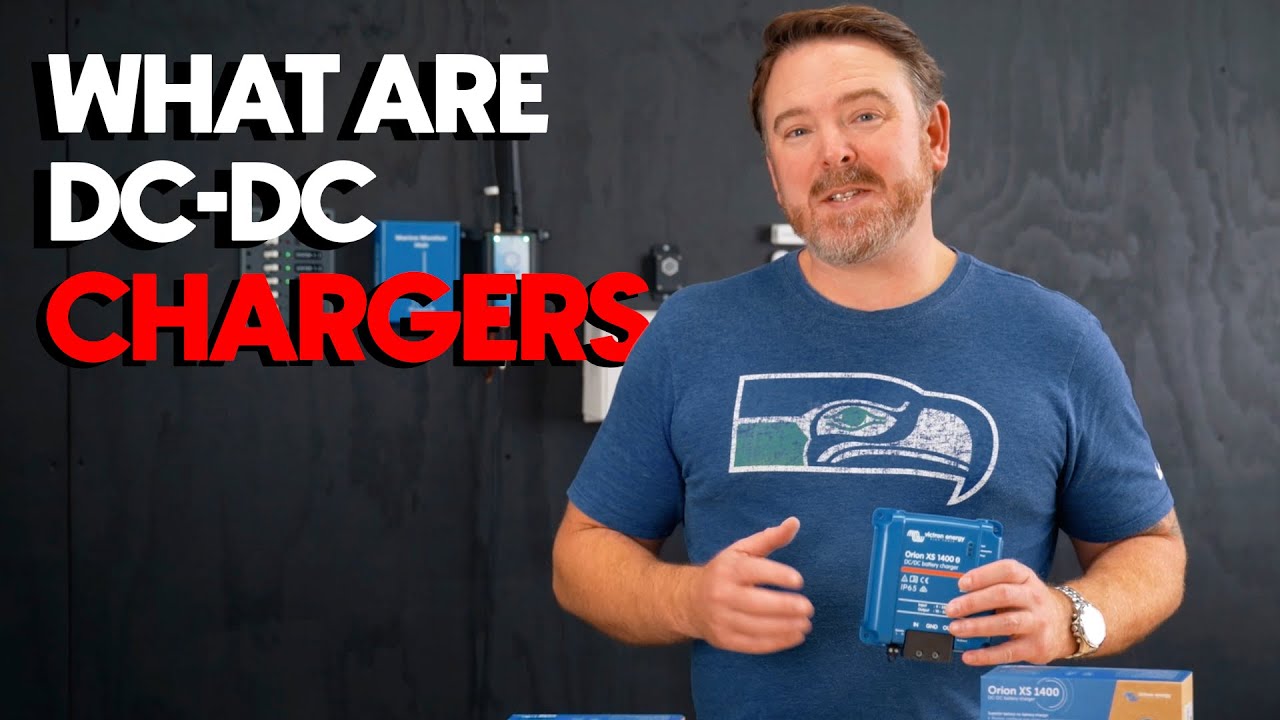
Victron Orion DC-DC Chargers and Converters: Full Guide
Victron lists both the Orion chargers and the Orion converters under the same “DC-DC Converters” category on their website. They have nearly identical chassis. They're priced in the same range. People buy the wrong one constantly. Wesley breaks down what actually separates them — and how to configure whichever one you have — in the video above.
The Core Distinction
The Orion product line splits into two fundamentally different devices:
Orion DC-DC Charger: Designed for battery-to-battery charging. It applies a multi-stage charging algorithm — Bulk, Absorption, Float — to properly charge a secondary battery bank from a source battery. Use it when your goal is to move energy from one battery to another and have it arrive correctly.
Orion DC-DC Converter: Designed as a stable power supply for loads. It takes a fluctuating DC input and outputs a fixed, stable DC voltage. Use it when your goal is to power a device or circuit that needs steady voltage, not to charge a battery.
Same box, same connectors, completely different internal behavior. The charger is a smart battery charger that happens to draw from DC. The converter is a regulated power supply that happens to be DC-to-DC.
Orion DC-DC Chargers: Battery-to-Battery Charging
What They're For
The most common application is alternator charging: using a vehicle's start battery (which the alternator maintains) to charge a separate lithium house bank while driving. Modern lithium batteries can't be charged directly from a standard alternator — the alternator's voltage regulation isn't designed for lithium, and the lack of internal resistance in a depleted lithium bank can overload the alternator.
An Orion DC-DC Charger sits between the start battery and the house bank, pulls current at a controlled rate, and applies the correct multi-stage charge profile to the house battery. The alternator sees a managed load; the house bank gets a proper lithium charge.
Another common application: a 48V trolling motor bank and a separate 12V electronics battery. Rather than maintaining two separate charge sources, an Orion-Tr Smart 48/12 steps the 48V bank down and applies a proper multi-stage charge to the 12V battery. One source, two banks, correct charging for each.
Isolated vs. Non-Isolated
Orion chargers come in isolated and non-isolated versions:
- Isolated: The input and output sides have separate grounds — no direct electrical connection. Required when the source and destination batteries don't share a chassis or common ground, or when you want to avoid ground loop issues.
- Non-isolated: Input and output share a common ground. Simpler, less expensive, sufficient when both batteries share a chassis ground (common in many RV and van applications).
If you're not certain, isolated is the safer default. See our full guide to isolated vs. non-isolated for a detailed breakdown.
Voltage Configurations
Victron makes Orion chargers across a wide range of input/output voltage pairs: 12/12, 24/12, 24/24, 48/12, 48/24, and more. Match the input voltage to your source battery and the output voltage to your destination battery.
Orion DC-DC Converters: Stable Voltage for Loads
What They're For
A battery bank's voltage isn't constant — it rises during charging and drops as it discharges. A 12V LiFePO4 bank swings from roughly 13.4V fully charged down to 11.5–12V near empty. For most loads, that range is fine. For sensitive electronics, refrigerators, and pumps that expect a stable voltage, that swing can cause problems: erratic behavior, shutdowns, premature wear.
An Orion DC-DC Converter takes the fluctuating battery voltage as input and outputs a fixed, precisely regulated voltage. The connected device sees stable power regardless of what the battery is doing.
Common Applications
- Sensitive electronics: Chart plotters, communication equipment, and other marine electronics that specify a narrow voltage range
- 12V refrigerators: A compressor fridge running from a 24V or 48V bank via a 12V converter gets stable voltage without the complexity of a dedicated 12V battery
- Pumps and motors: Consistent voltage means consistent performance, especially for flow-critical applications
Key Settings in VictronConnect
“Smart” Orion models include built-in Bluetooth and are fully configurable via the VictronConnect app — live monitoring, firmware updates, and all settings from your phone.
Charger vs. Power Supply Mode
In the VictronConnect settings, tapping the gear icon reveals the device function toggle: Charger or Power Supply. This means a single Orion DC-DC Charger can be repurposed as a converter if your system needs change down the line — useful for installations that evolve over time.
Input and Output Current Limits
One of the most important settings for alternator charging: input current limit. The Orion charger draws its input from the alternator via the start battery. An undersized alternator can be damaged by a charger pulling too much current continuously. Setting the input current limit caps how hard the Orion pulls from the source, protecting the alternator from overload.
The output current limit caps how much current goes to the destination battery, useful for staying within the battery's maximum charge rate.
Battery Presets
The battery preset menu in VictronConnect includes pre-configured charge profiles for Lead-Acid, AGM, Gel, and Lithium. Select the profile matching your destination battery chemistry, and the Orion applies the correct Bulk/Absorption/Float voltages and timing automatically. For lithium, always verify the preset voltages against your battery manufacturer's spec sheet.
Parallel Operation
Multiple identical Orion units can be wired in parallel to scale output amperage. Units do not need to communicate with each other — they operate independently and the currents add. Match models exactly (same part number, same firmware version) for parallel configurations.
Quick Selection Guide
| Goal | Device |
|---|---|
| Charge a lithium house bank from the alternator while driving | Orion DC-DC Charger |
| Charge a 12V electronics battery from a 48V house bank | Orion DC-DC Charger |
| Power a sensitive electronics circuit from a battery with fluctuating voltage | Orion DC-DC Converter |
| Supply stable 12V to a fridge from a 24V or 48V bank | Orion DC-DC Converter |
Browse the full DC-DC charger collection at Blue Marine. For more on alternator charging with lithium specifically, see our alternator charging guide. If you want help selecting the right Orion model and settings for your system, schedule a free consultation with our team.
Related reading:
Alternator Charging with Lithium Batteries: What You Need to Know
Isolated vs Non-Isolated: Which Victron Orion DC-DC Device Do You Need?
How to Configure the Victron MultiPlus-II for Lithium Batteries