
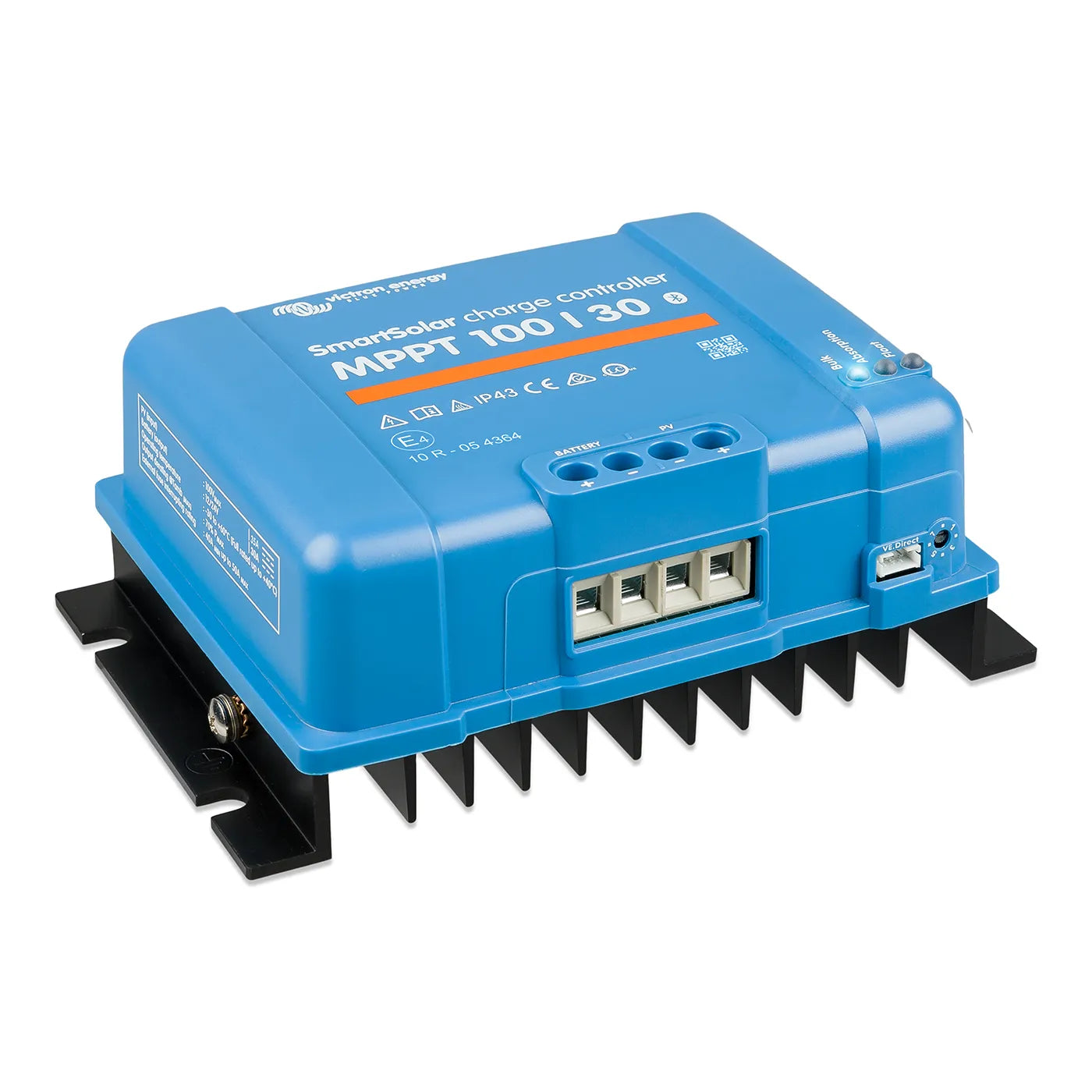
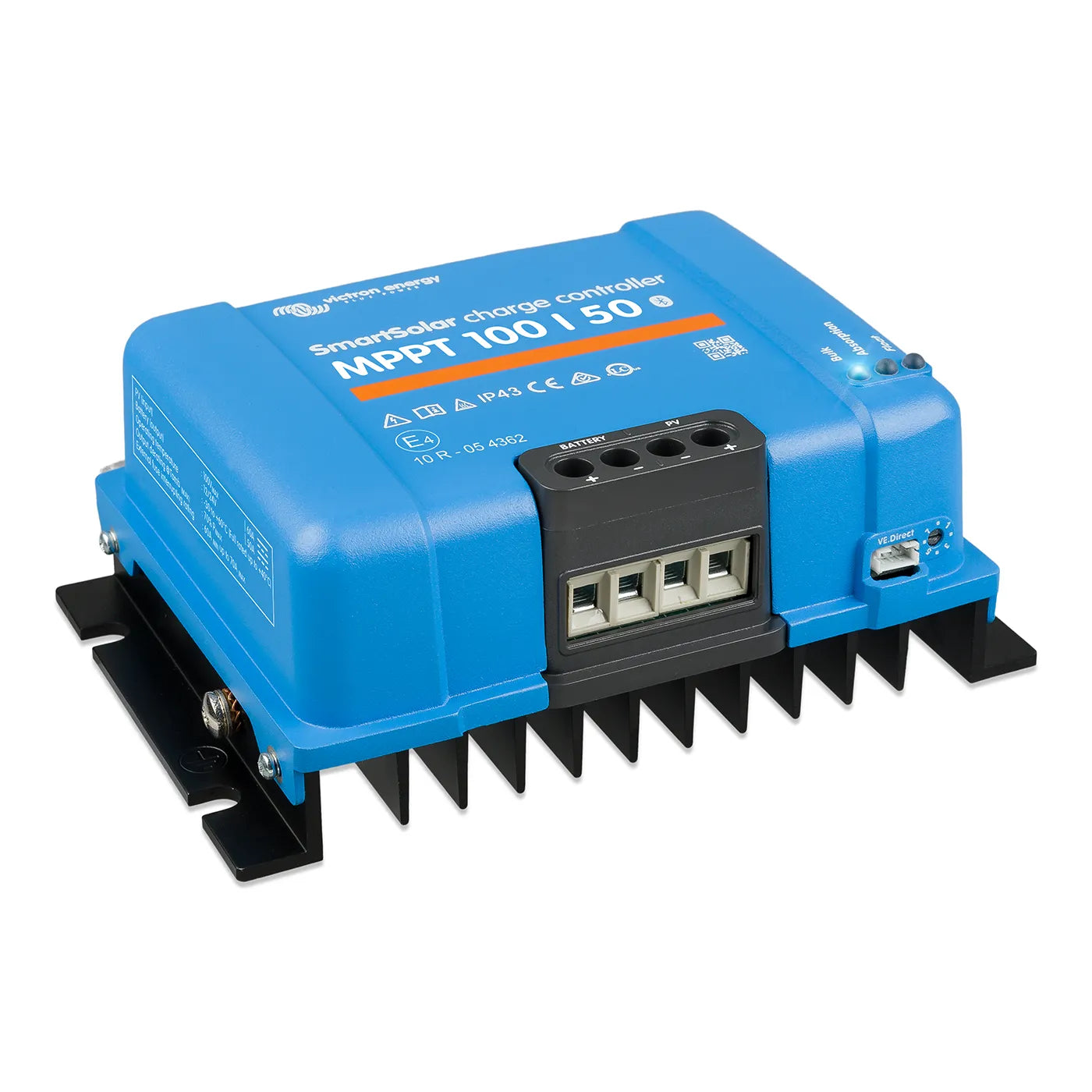
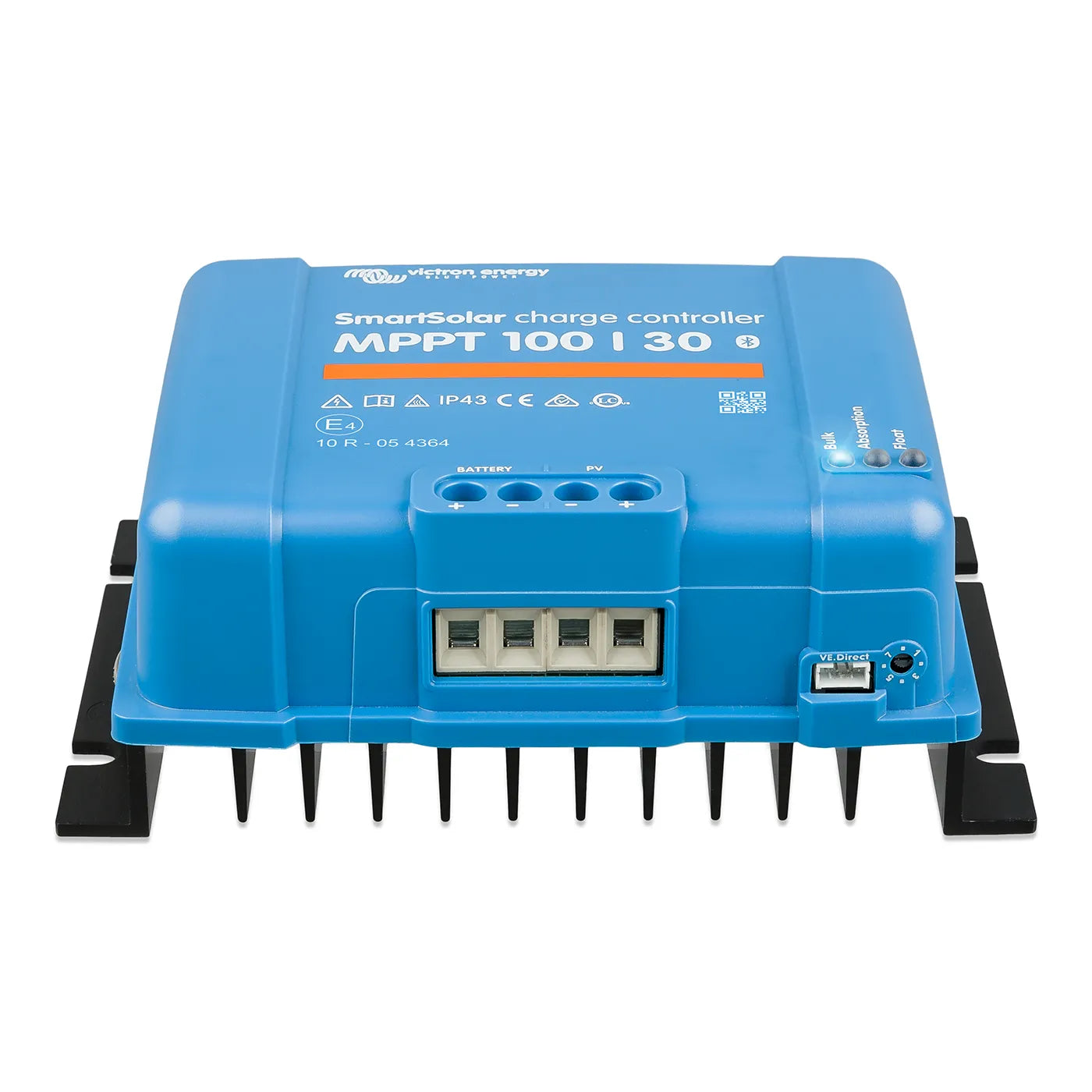
Victron SmartSolar Charge Controller MPPT 100/30 & 100/50

Free shipping over $49

60-day hassle-free returns
Two Bluetooth MPPTs, one decision — how big is your solar array?
The 100/30 and 100/50 are Victron’s mid-range SmartSolar charge controllers — the ones most cruising sailboats, mid-sized RVs, and small off-grid systems land on once the array gets past one or two panels. Both are Bluetooth-equipped, both auto-detect 12 V and 24 V battery systems, both run an ultrafast MPPT algorithm Victron rates at up to 98% efficiency, and both come with Victron’s 5-year limited warranty. The only meaningful difference between them is how much solar each one can push into your battery bank.
How to read the model number
Every Victron SmartSolar MPPT has two numbers in its name, and they tell you exactly what the controller can handle:
- First number = max PV input voltage. The maximum open-circuit voltage your solar array can deliver into the controller. For the 100-series, that’s 100 V. Enough for one or two panels in series; over that and you’ll need to step up to a 150- or 250-series.
- Second number = max charge current to the battery. The maximum amps the controller can push into your bank. 30 A on the 100/30, 50 A on the 100/50.
Combine those two numbers with the maximum PV wattage your specific system voltage supports, and you have everything you need to size the controller. Wesley walks the whole process — including panel math for series and parallel arrays — in our MPPT sizing guide.
Choose your controller
| Model | Max PV input | Max charge current | Max PV power @ 12 V | Max PV power @ 24 V | Max PV short-circuit current |
|---|---|---|---|---|---|
| SmartSolar 100/30 | 100 V | 30 A | 440 W | 880 W | 35 A |
| SmartSolar 100/50 | 100 V | 50 A | 700 W | 1,400 W | 60 A |
Both controllers support 12 V and 24 V battery systems with auto-detection. Neither supports 48 V — if you’re running a 48 V bank, look at the SmartSolar 150- or 250-series instead.
Which one’s right for your install:
- 100/30. Two 200 W panels on a 12 V sailboat. A single large panel on a van roof. Most cruising sailboat bimini arrays under ~440 W on 12 V (or up to 880 W on 24 V). The default mid-range pick.
- 100/50. Three or four mid-sized panels on a cabin top. RV roofs running 500–1,400 W. Off-grid sheds and tiny-house systems where you’ve grown out of the 100/30 but the array is still under ~700 W on 12 V (or ~1,400 W on 24 V).
You’ve outgrown the 100-series if your array’s open-circuit voltage will exceed 100 V (typically three or more panels in series), if your wattage exceeds the table above, or if you’re running a 48 V battery bank. Step up to the SmartSolar 150-series or 250-series.
Why these are the default mid-range picks
- Ultrafast MPPT, up to 98% efficiency. Victron’s algorithm tracks the maximum power point fast enough to harvest up to 30% more energy than a PWM controller and up to 10% more than a slower MPPT — the difference is real on a partly cloudy day at anchor.
- Smart partial-shading algorithm. When a shadow falls across part of your array, conventional MPPTs lock onto a local peak that isn’t the true maximum. The BlueSolar algorithm scans the whole power curve and locks to the actual maximum — useful on cruising sailboats with rigging shadow, or vans where a roof rack crosses the array.
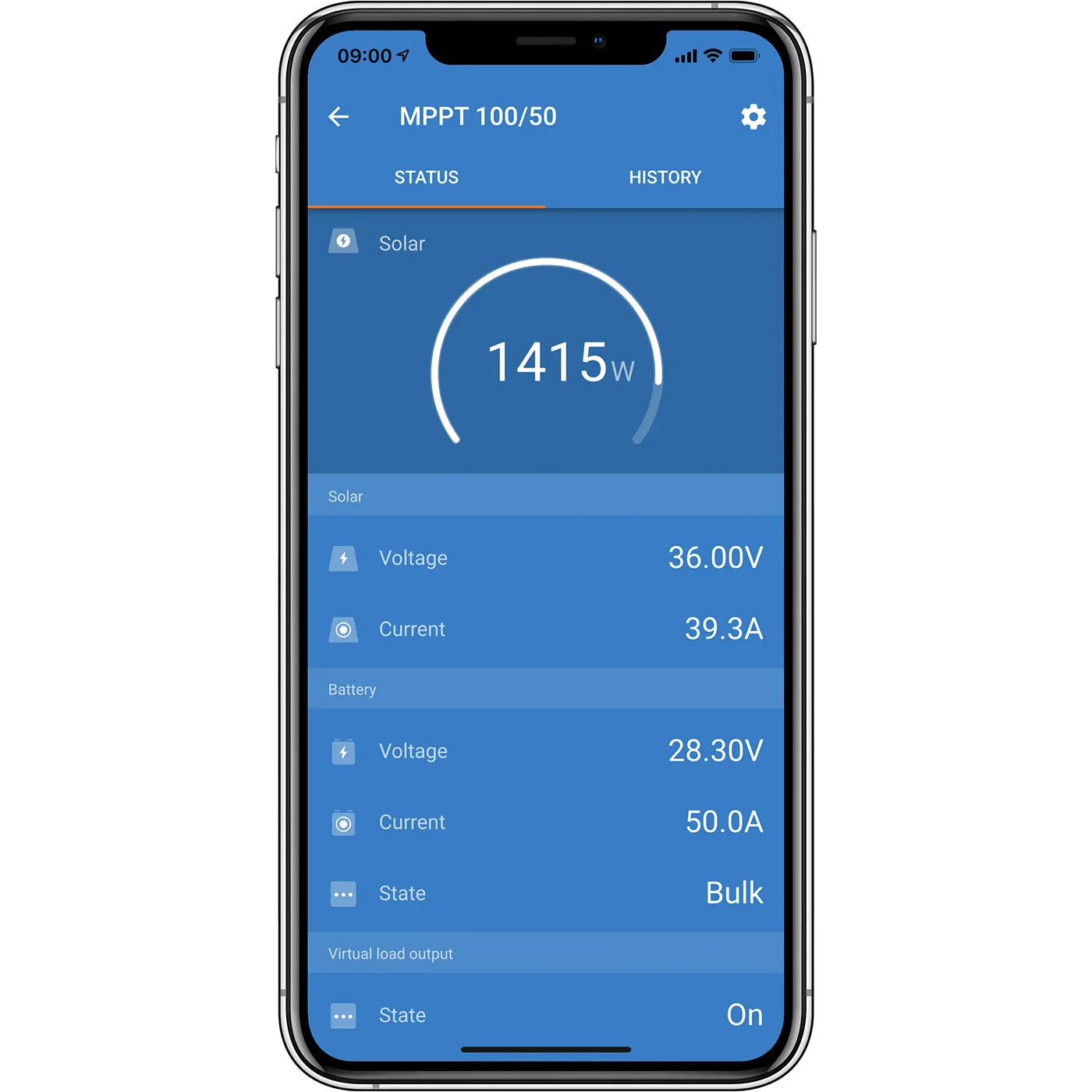
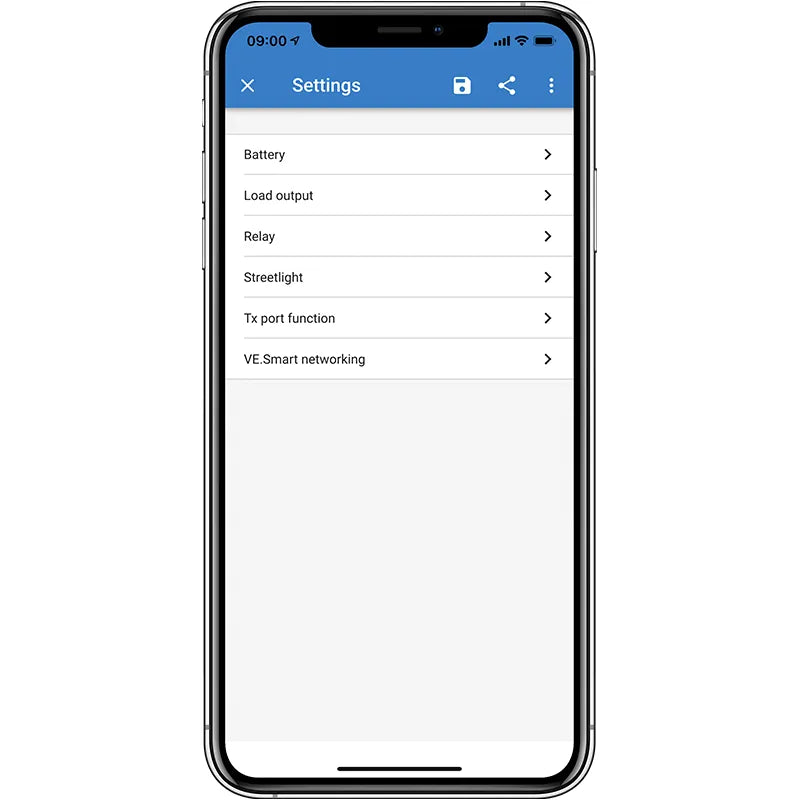
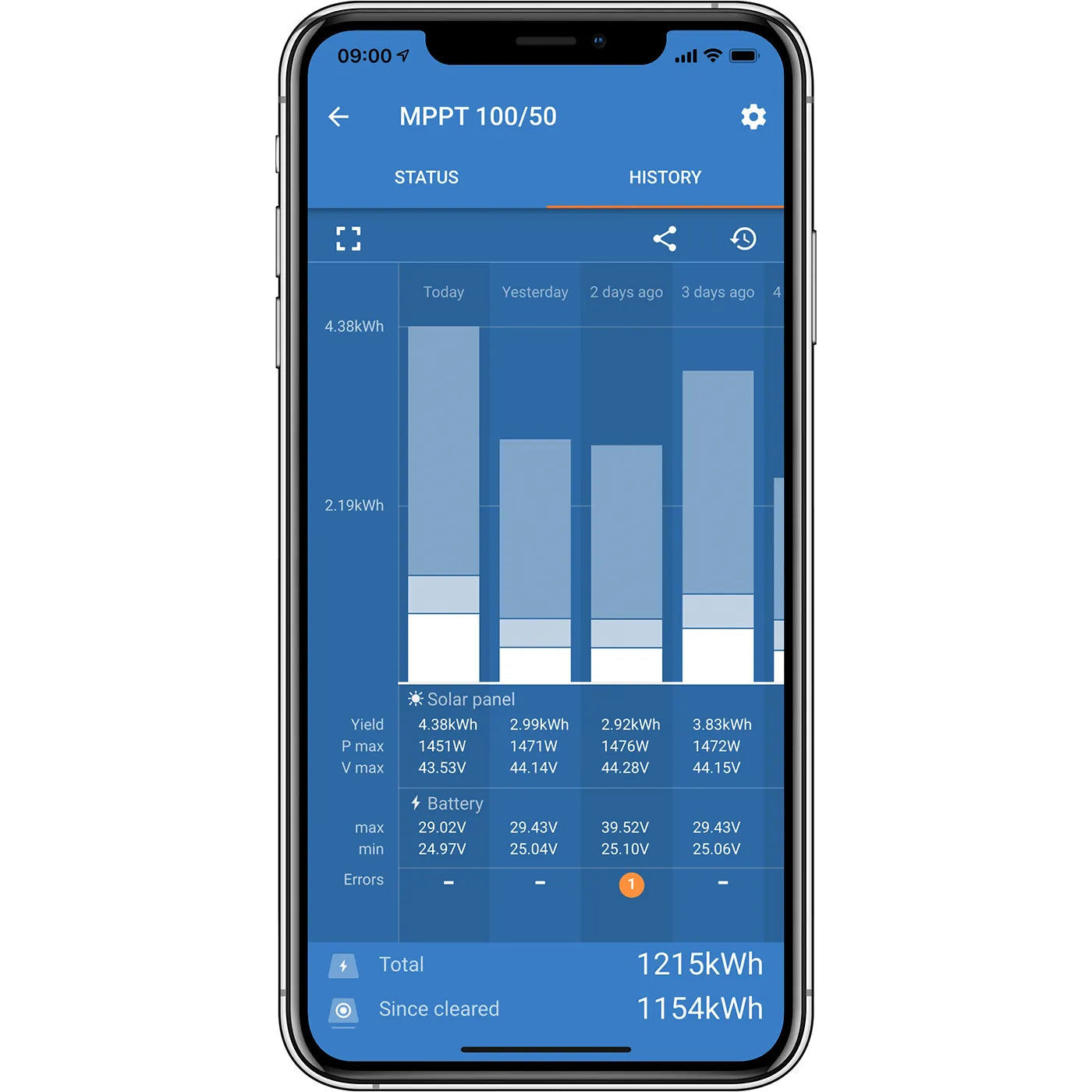
- Bluetooth built in. Configure, monitor, and update firmware from the free VictronConnect app on your phone or laptop. No external dongle.
- Auto-detect 12 V and 24 V. Plug into your battery bank and the controller figures out the system voltage.
- Multi-stage charging for every common chemistry. Eight pre-programmed profiles (lithium, AGM, gel, flooded, and more) selectable from a rotary switch, plus a fully programmable mode in VictronConnect. Critical: lithium banks must be set to the correct profile to avoid undercharging or stressing cells.
- VE.Direct port. Hooks into a Cerbo GX, Color Control GX, or Ekrano GX for live solar data, alerts, and remote access via VRM.
- VE.Smart Networking. Optional Bluetooth mesh between Victron devices — pair with a Smart Battery Sense or BMV-712 to get temperature- and voltage-compensated charging without running an extra cable.
- Recovers fully discharged banks. Will resume charging on a bank pulled down to 0 V. Useful after long storage or seasonal layup.
- Passive cooling. No fan, no audible noise, fewer moving parts to fail. Full rated output up to 40°C (104°F); rated to operate from −30°C to +60°C.
- 46 days of stored trends data. Battery voltage, current, temperature, and PV input history live on the controller — review the past month and a half of your system without a GX device.
Shared specs
| Spec | Detail |
|---|---|
| Battery voltage | 12 V / 24 V (auto-detect) |
| Charge voltage (absorption) | 14.4 V / 28.8 V default, adjustable |
| Charge voltage (float) | 13.8 V / 27.6 V default, adjustable |
| Charge algorithm | Multi-stage adaptive; 8 pre-programmed + fully programmable |
| Maximum efficiency | 98% |
| Temperature compensation | −16 mV/°C (12 V) / −32 mV/°C (24 V) |
| Self-consumption | 30 mA @ 12 V / 20 mA @ 24 V |
| Operating temperature | −30°C to +60°C (−22°F to 140°F); full rated output up to 40°C / 104°F |
| Protection class | IP43 (electronics), IP22 (connection area) |
| Protections | PV reverse polarity, output short circuit, over-temperature |
| Communication | Bluetooth (built-in), VE.Direct port |
| Power terminals | 16 mm² / AWG 6 |
| Dimensions (H×W×D) | 130 × 186 × 70 mm (5.1 × 7.3 × 2.8 in) |
| Weight | 1.3 kg (2.9 lb) |
| Certifications | EN/IEC 62109-1, UL 1741, CSA C22.2 |
| Stored trend data | 46 days |
| Warranty | 5 years from date of purchase (Victron limited warranty on power products; extendable to 10 years for a 10% surcharge) |
What’s in the box
SmartSolar charge controller, mounting screws, and the printed quick-start guide. Not included: VE.Direct cable (for GX integration), Smart Battery Sense or BMV-712 (recommended for accurate state-of-charge), a fuse appropriately sized to the charge current, PV cables, and battery cables sized to AWG 6 or larger.
Pair with
- VE.Direct cable — required if you’re integrating with a Cerbo GX or other GX device. We stock 0.3, 1, 1.8, 3, 5, and 10 m versions.
- MEGA fuse on the battery side — Victron’s installation manual specifies 35–40 A for the 100/30 and 55–70 A for the 100/50. We typically install a 40 A MEGA on the 100/30 and a 60 A on the 100/50 unless your specific install calls for something different.
- Smart Battery Sense — small Bluetooth sensor that improves charge accuracy by reading battery voltage and temperature at the bank instead of estimating at the controller. Pairs to the MPPT through VE.Smart Networking with no extra cabling.
- BMV-712 Smart Battery Monitor — if you want a panel-mounted SoC display and bidirectional voltage/temperature data into the MPPT.
- Cerbo GX MK2 or Ekrano GX — for always-on monitoring, system-wide integration, and remote access through the VRM portal.
- Solar panels — we carry Sol-Go, SunPower, Lumera, and our own Blue Marine flexible panels. Email us with your array layout and we’ll confirm the controller is sized correctly.
FAQs
Q: Can I use this with a lithium battery?
Yes — lithium is one of the eight pre-programmed chemistries. The critical step is selecting the right profile in VictronConnect during setup. For Victron lithium banks, use the chemistry-specific profile (e.g., “Smart Lithium” or “Lithium NG” depending on which battery line you’re running). For third-party LFP, follow the battery manufacturer’s charge voltage recommendations. The 0 V recovery function will even reconnect a Li-ion bank whose BMS has disconnected.
Q: How many panels can I wire in series?
Add up the open-circuit voltages (Voc) of your panels at cold temperature (Voc rises in cold weather; use the panel datasheet’s temperature-corrected value). The total has to stay below 100 V. The PV array’s short-circuit current also has to stay below the controller’s rated max (35 A on the 100/30, 60 A on the 100/50). If you’re unsure, send us the panel datasheet and we’ll confirm.
Q: Can I run this on a 48 V system?
No. The 100/30 and 100/50 are 12 V/24 V only. For 48 V systems, look at the SmartSolar 150- or 250-series controllers — they support 48 V battery configurations and accept higher PV input voltages too.
Q: What size fuse do I need on the battery side?
Per Victron’s installation manual, the recommended range is 35–40 A for the 100/30 and 55–70 A for the 100/50. We stock MEGA fuses in all of those values. Choose the higher end of the range if your system runs near rated output regularly; choose the lower end if you want tighter overcurrent protection.
Q: What kind of battery cable should I use?
Victron specifies AWG 6 (16 mm²) flexible multi-stranded copper cable for the battery and PV connections, with individual strand diameter no greater than 0.4 mm (class 5 or higher stranding). Don’t use solid-core or coarse-stranded cable — the smaller contact area causes the burnt terminals we occasionally see. “Tri-rated” class 5 cable is a solid choice.
Q: What torque do the screw terminals need?
1.6 Nm on both the battery and PV terminals. Worth using a torque screwdriver — under- and over-tightening both cause issues.
Q: What’s the right install order?
Connect the battery first, wait 10 seconds for the controller to auto-detect 12 V or 24 V, then connect the PV, then VE.Direct if you’re using it. Doing it out of order can disable auto-detection.
Q: Do I need a Cerbo GX to use this controller?
No. The VictronConnect Bluetooth interface is fully functional on its own — including 46 days of stored trend data. The Cerbo GX adds always-on monitoring, remote access via VRM, integration with the rest of a Victron system, and the ability to coordinate charging across multiple Victron devices — useful but not required.
Q: How hot can I install this controller?
The 100-series is rated to operate from −30°C to +60°C (−22°F to 140°F), but you only get full rated charge current up to 40°C (104°F). Above that, the controller derates automatically to protect itself. For engine-room installs or hot van rooflines in summer, mount it in the coolest accessible location and allow airflow above and below.
Q: What’s the warranty?
5 years from date of purchase, extendable to 10 years for a 10% surcharge applied before the original term expires. Standard Victron limited warranty applies; damage from reversed polarity, lightning, mechanical shock, or insufficient terminal tightening is not covered.
Still sizing your array? Read Wesley’s MPPT sizing guide for the full walkthrough, or email support@bluemarine.com with your panel specs and battery voltage — a tech will confirm the right controller and fuse before you order.
Warranty Information
Shipping & Returns
We offer free shipping over $49. Lithium batteries & oversize items may have an applicable shipping charge.
We know returns are no fun so we aim to make the return process as hassle free as possible! We have a 60-day return policy, which means you have 60 days after receiving your item to request a return.
Lithium batteries and products with lithium batteries inside are non returnable: Due to carrier regulations surrounding the shipment of lithium batteries (classified as a fully regulated hazardous material), we are unable to accept returns unless arranged locally. We appreciate your understanding and encourage you to contact us with any questions prior to purchase.
For more information on returns, visit our return policy page.
Product Attachments
Choose options

About Blue Marine
Nationwide Shipping from Our Warehouse in Seattle
Knowledgeable technicians, firendly advice and fast shipping.